Showing posts with label sourcing. Show all posts

Friday, November 21, 2008

Do You Need a Supplier Contract?

No. If everything is going really well, and always will, then don't bother. You, my friend, are an enlightened master, but you don't need me to tell you that.

For the rest of us, likely you do. There are scores of articles about how to source product from low-cost countries. I've written several myself. I usually dance around the topic of contracts, and am even uncertain about what to tell my clients. I do have experienced legal advisors that I trust, and I count on them to help me figure these issues out.

Let me give you a couple of scenarios, one with a contract, one without. Please do seek legal advice before you finalize a sourcing project. As the old saying goes, an ounce of prevention is worth a pound of cure.

Scenario 1: I source a small stainless retaining clip. The value of the clip is a few pennies. The mould only cost me $200. My staff performs QC checks prior to each shipment, and I buy sufficient quantity to cover 90 days of supply. My relationship with this vendor is great, and I've used him for a couple of years. I also know that I could likely move this project to another vendor in less than 90 days, and that my mould cost will be less than $1000. I have no contract, but do issue detailed purchase orders with each order. I'm comfortable with this arrangement.

Scenario 2: I work with a partner to source a large aluminum casting for the automotive industry. The cost of the mould and tooling was over $30,000. The part is complicated and we ship monthly. Of course, relationship and VERY pro-active project controls are necessary. My risk, however, is tremendous if there is a problem. I certainly need a contract on this one!! If things go wrong, I will need to recover the tooling, which my partner and I own! I'll need to recover damages, as I would likely miss shipments if I needed to move the project. With the right team, legal remedy is possible in China.

The last contract that I worked on in China cost about $4,000. Expensive, yes, but if your tooling costs $30,000, it's worth it. If you don't include vendor disagreements as part of your failure mode and effects analysis, perhaps you should. The corresponding process control could be a well-written, enforceable contract.

Wednesday, November 12, 2008

CSA International Opens Lab in GuanZhou

From Marketwatch, CSA has officially opened a test lab in GuangZhou -- read more here. Most of the work I've done which required CSA certification was done in the US. This could be a more time- and cost-efficient option for any of you exporting to North America. There are several high-quality electrical power supply manufacturers in Guandong Province, and I can think of several nice scenarios utilizing the GuangZhou-based lab to achieve and maintain certifications on those products.

If any of you have visited, or used the new lab, please let us know!

Saturday, October 25, 2008

China Supply Chain Management -- What's Old is New.

When people find out I work in China, they often want to know my opinion on the most recent China-related quality issue. My first thought is always "when did companies stop managing their supply chains?"

I know that each event is different, and there's usually plenty of blame to go around; however, according to ISO 9001:2000, section 4.1

"Where an organization chooses to outsource any process that effects product conformity with requirements, the organization shall ensure control over such processes. Control of such outsourced processes shall be identified within the quality management system."

ISO 9001:2008 will clarify that "the type and extent of control to be applied to these outsourced processes shall be defined within the quality management system."

Also, ISO 9001:2000 section 7.4.3 Verification of purchased product:

"The organization shall establish and implement the inspection or other activities necessary for ensuring that purchased product meets specified purchase requirements.

Where the organization or its customer intents to perform verification at the supplier's premises, the organization shall state the intended verification arrangements and method of product release in the purchasing information."

I'm not claiming that purchasing product in Ningbo is the same as purchasing product in Flint, MI. Nor am I claiming that ISO 9001 is universally applied in China (I'll post on that at a later date). Many of my clients are small companies that don't have ISO 9001 certification.

I'm also one of those China experts that likes to write articles about my fail-proof techniques for insuring success with your sourcing operation. But let's be very clear, ISO 9001 has long required companies to manage their supply chains, no matter where they are. In short, the challenges for managing your supply chain are different in China and the US, but the requirements are exactly the same.

Tuesday, October 21, 2008

Critical Steps in a Sourcing Project

It's always good to refresh some basics. Let me point you to a short article that I wrote some time ago about sourcing basics. I've seen a couple similar lately on China-related sites, so now's a good time to bring this up again.

Critical Steps in a Global Sourcing Project

Wednesday, September 17, 2008

China: Cheap No More

I just came across this piece from Fortune Small Business, the online edition. The story is similar to others we've all read recently -- China's costs are rising. For you China veterans, there's nothing in there that will surprise you. Costs are rising due to new employment and environmental laws, coupled with increases in commodity prices and a weak US dollar. The interesting part of the article is that it approaches the issue from the standpoint of small business.

I often read small business journals, as much for inspiration as for actual information, and I'll likely add this site to my list of regular scans. It looks like there's some good stuff here, including several profiles of very small businesses operating internationally.

Friday, August 29, 2008

Vendor Management

Those of you who have done business in China for any length of time know that the marketplace is fluid, to say the least. Companies rise and fall, reinvent themselves, destroy themselves, and exchange key staff at a dizzying rate. If you're dealing with a tier one automotive supplier, you will probably disagree with my observation, but if your volumes are smaller, like mine, then you've dealt with these small, rapidly morphing companies.

Most of my experience has been in and around Ningbo. In such a rapidly developing area, company changes are accelerated. There are many great companies in Ningbo, but a technique is needed that will help make sure the company you're doing business with today is the same one you started doing business with yesterday.

Most of you are familiar with vendor management programs. Larger companies have formal vendor management systems that rank all vendors on such things as delivery accuracy, on-time delivery, number of identified defects, number of outstanding non-conformances, etc. For smaller companies, it's still important to have a program. In fact, it's so important, that you should take the time to develop a procedure, just to remind yourself on occasion to spend a few minutes thinking about your vendors. For the purpose of this discussion, let's assume that you have already performed an initial audit and vendor qualification.

Here are some ideas to get started, and to use as the basis for a procedure:

1. For every shipment from a vendor, it's likely you perform some sort of source or receiving inspection. Put a copy of the results in a vendor file. Make note of any non-conformances.

2. In the vendor file, maintain a copy of any non-conformances. Be sure to pay special attention to any non-conformaces for which the vendor hasn't completed corrective action.

3. For every shipment from the vendor, make a note about requested delivery dates and quantities.

4. Make sure you capture any price changes throughout the year.

5. Dust off your initial audit form. Take the time to do a quick survey of the company, paying special attention to any findings made during the initial audit.

6. Set an appointment on your calendar to take a quick look through your vendor files at least annually. Take corrective action on any areas of concern you uncover.

7. If you haven't personally visited that vendor in several months, take the time to swing by. Now is a great time to bring along your audit form and do a quick survey. Have lunch with the owner, and remind him how much you value his company.

In a market changing as quickly as China, especially in second and third-tier cities, it pays to have a vendor management program. Do you have one? What else do you measure?

As a quick aside, when I audit companies, I always see what kind of vendor management program they have in place for their suppliers. This helps reduce sourcing risk, by making sure your vendor is dealing with the best possible suppliers.

Tuesday, August 19, 2008

The Best Cost Might Be Right Next Door

China Success Stories just published this piece by Terri Morgan of Wudang Research Association -- http://www.chinasuccessstories.com/2008/08/14/china-sourcing-quantity-price/

I certainly agree with the point of the story -- when the total costs are considered, China may not be your best option. In fact, you may find the best price locally.

In my business, I consider myself something of a teacher whenever a new client calls. (I need to think of a way to get paid for this! Oh well, when the time is right, they will call me again) I certainly don't want to make promises I can't deliver on, or find myself losing money on parts I source!

I once worked with a company that had moved some brass machined components to China. The volumes were VERY high, so it seemed a good idea; however, there were some fairly complex features that resulted in high scrap rates, even at good Chinese machine shops. It turns out that their US operation had developed some very specialized machine tools over the course of 30+ years, and these machines had evolved to the point that very little operator interation was required. The short story -- moved the production back to the US. (The other option would have been to move the machine tools to China. Of course, that could mean that suddenly your competitors now have access to the same source of product as you!)

I believe in doing the work up front, to improve the odds of a successful sourcing project later. Part of that work must involve a business case. Is the project justified? Take a look at the total cost of the product from China, including shipping, insurance, and verification by a third party. Consider the non-recurring costs associated with the project such as tooling, engineering support, factory audits, etc. Is the NPV still positive? Sourcing projects involve risk. When the opportunity is right, the returns can be impressive, but all too often, companies run headlong to China hoping for huge savings, only to be disappointed and frustrated. Do your work up front, and look at sourcing projects as you would any other investment in your business.

Wednesday, August 13, 2008

Outsourcing Quality Body of Knowledge Part I

I just finished reading a very nice article in the August edition of Quality Progress called "In the Know." Govindarajan Ramu nicely lays out a Body of Knowledge (BoK) for managing outsourcing projects. I plan to research this further, as I have been developing my own sourcing BoK which I plan to publish at some point in the future. Look for more about this article future posts-- lot's of good stuff here.

One point I'd like to talk about now is the use of the subject matter expert (sme). I've seen countless examples of a well-meaning company sending a SME to a local manufacturer, only to have the quality fall apart soon after he leaves. Having a subject matter expert participate in knowledge transfer is necessary, but won't guarantee a quality product unless their knowledge is properly documented. Manufacturing and quality managers must take the knowledge from the SME, and convert it to useable processes and procedures. Most importantly, the local managers must be able to train new staff in the transferred knowledge.

We've all heard the term "tribal knowledge" when describing local processes that are known to work well, but are not documented. "Tribal knowledge" can be trained, but is impossible to maintain when the manufacturer is on the other side of the planet from the subject matter experts.

Tuesday, August 5, 2008

Proudly Made in China?

Just came across this in the China Sourcing Blog: http://www.chinasourcingblog.org/2008/07/chinas-no-longer-cheap-from-lo.html

This article covers what we all have been facing, rising costs in China, and makes particular reference to Foxconn's recent announcement to move factories from ShenZhen to northern China in search of lower costs. I know we're all looking elsewhere, and the jury is out as to where the next hot, low-cost manufacturing country will be -- in Eastern Europe, Vietnam, Phillipines? Will the supporting infrastructure in these countries develop quickly enough to really challenge China's manufacturing sector?

Of course, there has also been much talk about China's attempts to move up the technology ladder by rejecting lower cost, less value added product, in favor of more advanced, high technology manufacturing. Those of us sourcing in China have seen the VAT rebate changes that favor more value-added manufacturing.

To me, it seems that the biggest challenge for China is not manufacturing, but breaking the negative emotions associated with "Made in China." I guess I'm not old enough to remember when made in Japan was a bad thing. I think the Japanese make some of the world's greatest products (certainly cars), and don't remember ever thinking any differently. How long did it take for Japan to change the stigma?

Friday, August 1, 2008

Convergence

I had a fantastic evening! My wife and I spent the evening at a private club near Lake Ontario. The weather was perfect -- sunshine and a light breeze. The beer was cold, and the company friendly. I spent a few minutes talking to the owner of a machine tool manufacturer. Of course, the topic turned to China. He explained that his business is growing, and that he is selling more and more machine tools into China. With the abundance of very cheap (and worth every penny) machine tools in China, why would any Chinese company spend the money to import an American machine?

In The World is Flat , Thomas Friedman explains the triple convergence. Convergence two is the evolution of flanking technologies and business processes needed to make the most of new technology.

Friedman is spot on, and it couldn't be more obvious than in the machine shops of China. I'd often remarked that I could produce massive improvements in Chinese machining productivity and accuracy by opening a school for operations managers and CNC programmers and setup people. (This isn't universally true -- of course, there are some fantastic machine shops in China. They are rare.) I often joked that most shops ran CNC equipment like they were running old manual engine lathes. In short, they were spending the money, but not seeing the gains in accuracy and productivity simply because they were running the new technology the same way they ran the old technology.

Things are changing. A more competitive market has forced Chinese machine shops to get the most out of their equipment. They have invested in training, and the convergence of skill and technology is increasingly apparent. This was confirmed by my conversation this evening. The Chinese are seeking training, and his distributors are providing it, making his machine tools a real value in the Chinese market.

Friday, July 25, 2008

OEM Agreements

Please take a look at this post from the excellent China Law Blog:

http://www.chinalawblog.com/2008/05/why_you_must_have_a_china_oem.html

I've been involved in this type of situation before, and have had the good fortune of working with Steve Dickinson myself. I won't repeat what has already been said -- please think about this sort of thing before it's too late!!

Wednesday, July 23, 2008

Vendor Evaluation (or You Can't Know Everything)

I'm currently in the middle of a crisis. The lessons learned during this bit of trouble will certainly make me smarter, and hopefully, will help you avoid a similar situation in the future.

I've done business with a company for about three years. Let's call them SH -- it's representative of their company name, and also reminds me of a certain phrase, as in "went to SH*#!" I've done several projects with SH, and have been quite happy.

So why the trouble? I have a good process which I follow. I know much about SH. I've audited them, I've studied them, I know the owner and the key staff. How could it have gone wrong?

I don't know all the reasons why it went wrong. I do know that the technical director left, and not on great terms. That didn't seem like an immediate problem, as I knew the other department heads, and they seemed sound. I do know that some family members were being placed in key positions, but heck, I knew the owner, and he's a great guy, so no problem. Several other staff members left, but that's ok, SH is a good company, they can find new people. So my castings are running a bit late. Well, this is likely just a temporary problem.

Now I'm not claiming that this rapid company disintegration is a problem unique to China. With smaller US companies, changes in the upper echelon can have immediate and disastrous effect. In fact, one of my former employers went bankrupt soon after junior took the reigns from daddy. This can happen anywhere, but I've seen it happen twice in China, and it has happened both times with the departure of senior staff and replacement by family members who were completely incapable of performing the required job. Is that a sign to find a new vendor? It could be, but it's certainly a sign to pay more attention.

So what was my mistake? I certainly followed my process, and still things went bad! Here are my takeaways from this:

  1. Have a vendor management program and follow it. Even if informal, you should periodically re-audit, and track vendor performance.
  2. Dual source when possible. Due to complexity and volume, I couldn't practically dual source this part.
  3. Keep a list of qualified alternates in case you need to move quickly, and never stop hunting for new and better vendors. Does this mean don't build relationships with vendors? Absolutely not!! Just be prepared to move if things get bad -- I have a good relationship with this vendor, but not so good he's going to repay me for the money I'm going to lose!
  4. Don't be lazy!! If things start to smell bad, they're bad! I knew this company was starting to have troubles, it's just that it took so long to get this part qualified, and....
  5. Know who owns your moulds, if applicable, and don't be afraid to move them. Fortunately, I do own these moulds, and can move them to a new vendor.

Saturday, July 19, 2008

Which is your factory?

First of all, let me say that the below picture is not meant in any way to degrade Chinese factories. I want to illustrate the vast differences that one may encounter in China. This picture is of a fairly typical, high-pressure aluminum die-casting plant. There is no central melt system, machines are fed with hand ladles, and more importantly, mould maintenance is sometimes minimal.


The next picture is a fairly new automated heat treating line.
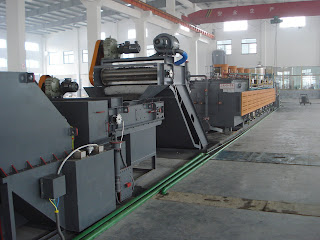


The pictures are of very different technologies, but I want to illustrate the difference in cleanliness, organization, and quality of equipment. And yes, the air really is that bad in the first factory!!

So which one makes the best parts? Well, both. You have to know the capabilities of the factory that is making your parts, and how those capabilities match up to the specifications of your parts. If your definition of good is parts that meet your requirements, and you know that the plant's processes are capable of making parts inside your specifications, then either plant will do nicely!

This returns us to the point I am always driving at, that you must do your homework before you begin. First, you must have a clear specification, and it must be clear to your Chinese partner. Second, you must audit the factory you are working with. Third, you must have a systematic process to qualify both the factory you will use and the parts they will make.

Friday, July 18, 2008

Random Guidelines

China sourcing can be done successfully. I know there are times when you don't believe that. There are times I don't believe that. I know that your chances of success are greatly improved by following a systematic process. Does that mean it's slow? It doesn't have to be slow, but you must do your homework first, before you start contacting vendors. I'll go through more detail in future posts, but for now, let's start with some random little nuggets that you'll find helpful:

http://www.go-qss.com/Some%20Random%20Guidelines.pdf

I welcome questions and comments! We'll dig deeper into actual process in the future, including specifications, vendor audits, and inspections! This is a repost from some of my earlier blogs, but it's such good general information, I think it's appropriate.